Saturday, 24 August 2019

Far and Wide


Last November I set myself a target of 200 species in Spain by the end of this summer. I realised that to achieve my goal I would need to travel a little further afield and my first destination was Sierra Magina in Jaen province. It was a bitterly cold day with frost on the ground at the higher altitudes and few birds showing. We were lucky enough to catch sight of three Golden Eagles soaring above the mountain peaks and a Ring Ozul (a lifer) feeding on berries. The only other excitement for the day were a few Crossbills that sat obligingly on top of the pines. 

The next few trips were to the north of Cordoba. In Sierra de Andujar we a saw a couple of Lynx as well as great views of a Spanish Imperial Eagle. In the ZEPA Alto Guadiato we watched Cranes coming into to their nighttime roosting sites, their loud trumping calls alerting us to the presence before we could even see them. They spend the day feeding on acorns and other seeds before gathering to fly to their roost sites. We watched them landing on a small island in the reservoir which offered them protection from terrestrial animals such as foxes. They winter here and their arrival is also one of the highlights of the colder months. Oddly, there was the belief in Doñana that eating crane meat which had been cooked on a grill with seven different types of wood would result in a long life. I am glad that this belief no longer exists!  


Cranes

In the same area we observed a group of Great Bustards in a distant field. And nearby, at the Castillo de Santa Eufemia we had superb views of a Black Vulture, a Golden Eagle, Griffon Vultures, Kestrels and Black Wheatears.

View from the castle at Santa Eufemia


Winter soon turned to spring and I was still about 20 birds short of my target. A trip to Cadiz for work gave me the perfect excuse to go to Vejer de la Fronter in search of one of the world's most threatened birds - the Bald Ibis. Listed as Critically Endangered on the ICUN Red List, this population of 80 or so birds is as a result of a reintroduction programme. A newly constructed viewing platform allowed us to observe these comical-looking birds at close quarters as they collected material to repair their nests.

Bald Ibis

In May I travelled to Brazo del Este near Seville, which is fast becoming one of my favourite birding sites because of the sheer number of birds it is home to. With much help from my friend Ron, we got 58 species in one day including Montagu's Harriers, Black Kites, Little Bitterns, a Squacco Heron, Purple Herons, Spoonbills, Flamingos, Glossy Ibis, Avocets, Curlew Sandpipers, Wood Sandpipers, Redshanks, a Stone Curlew, Collared Pratincole, Gull-billed Terns, Whiskered Terns, Great Reed, Warblers, Black- Headed Weavers, and a Roller.
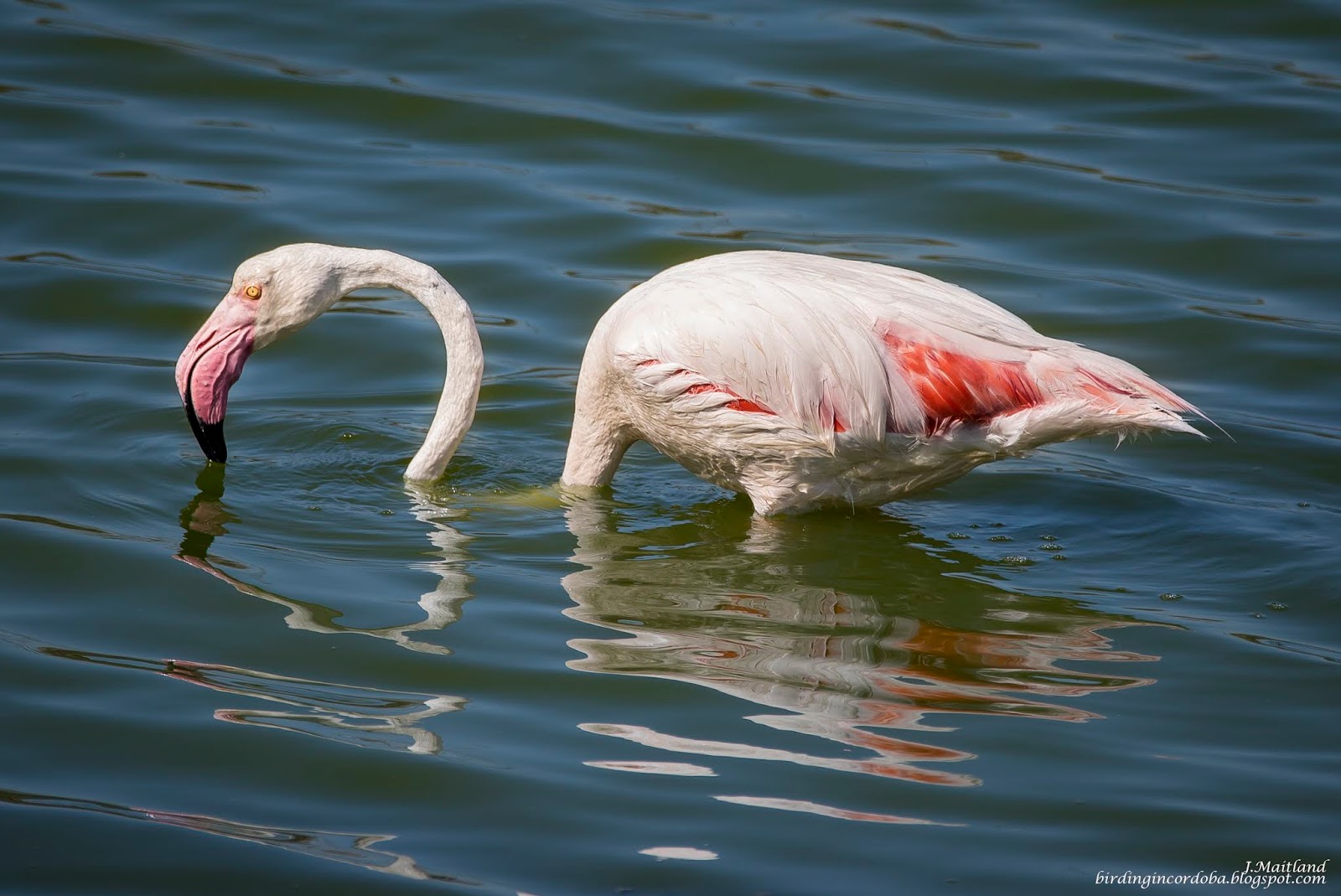
Flamingo

The star of the day was a Savi's Warbler which was calling loudly from the top of a reed. Its distinctive song made distinguishing it from other members of the warbler family quite easy, once Ron told me what to listen for. The days birding gave me four new species for my list and brought me ever closer to my target.

Great Reed Warbler

We also found this large nest which I presume is home to either the Yellow-Crowned Bishop or the Black Headed Weaver.


In July I heard of a real rarity, a Red-footed Booby, which had been sighted in Caleta de Velez, Malaga. Ron and I set off in search of it but were disappointed to see that it was not on what we had been told was its favourite floodlight nor in the surrounding area. The local population of Monk Parakeets, with their bright green plumage, provided a brief distraction as they squawked loudly from the palm trees around the harbour area. Not a native species to Spain, SEO estimates that there are at least 20,000 of them across the country. They were brought here as pets and escaped or released birds have quickly formed a 'healthy' population in many Spanish cities. This rapid growth has led to calls for them to be eradicated because of the damage they cause to native flora and fauna. 

Monk Parakeet

We continued our wait  and watched a Cory's Shearwater skillfully gliding over the waves off the coast and Audouin's Gulls on the beach.

Audouin's Gull

After an hour or so we concluded that the Booby had probably gone out to sea to feed and so we drove on to La Charca Suarez in Granada province. This is a site I had read a lot about but had never had the chance to visit. It is a haven for wildlife surrounded by apartment complexes and industrial estates. The infrastructure for birders is great with many hides overlooking the lakes around the park. And despite only having an hour to look around before they closed the gates, it did not disappoint. We had close views of a Squacco Heron, Purple Swamphens, Red Crested Pochards, Little Grebes and Red Knobbed Coots, which were another first for me. These are one of the most endangered birds in Spain and were released here in the 90's as part of a reintroduction programme. The look very much like a coot except for two red nodules on their heads which they have during breeding season.

Red Knobbed Coot

After stopping for a drink we decided to call in again at Caleta de Velez on our way home. It proved to be a good decision as we immediately located our target bird, the Red-footed Booby. It was busy preening and seemed quite unaware of the gulls which were put out at losing one of their perches to this strange foreigner. I say this as it is usually found around 9,000 kilometers away in the Caribbean. This juvenile, with its brown plumage, blue eye contour and red legs, had caused quite a stir in the birding world. It is what the Spanish call a 'megarareza' and had even had an article devoted to it in El Pais. We watched it for about half an hour, hoping it would take off to allow us to see it in flight but it didn't oblige. It was another one for my Spain list (even if it isn't in my Collins) and meant that I was on 199. Just one more to go!

Red Foot Booby

After travelling far and wide across Andalucia to find some rarities, number 200 came closer to home in the Sierra Morena. Again with the help of my friend Ron we saw a pair of Western Bonelli's Warblers. They were quite hard to get in the binoculars because they were constantly moving as they hopped between branches looking for small insects and occasionally picking one up from the ground before darting back to the cover of the leaves. Of a similar size to a Willow Warbler, what really made them stand out was their silky white underparts. 

There are of course many more birds which I have yet to see in Spain, some quite common, and with the variety of habitats that Andalucia has to offer I am sure it won't be too long before I can add them to my list. 


Wednesday, 7 November 2018

Aiming for the Sky

After talking to fellow birders about their list of species seen in Spain, I decided to count mine. I had 169 which, while modest, pleased me as it had been achieved in about 18 months. And with the 200 mark relatively close I decided to aim for the sky and set myself the challenge of reaching it by next summer (a deliberately vague deadline). However, I soon realized that this was going to be tougher than I thought with many of the species seen around Cordoba already ticked off. 

Black Stork, White Stork, Little Egret and Grey Heron hanging out together next to the rice fields

With this in mind I decided to team up with a friend and explore new territory. Brazo del Este is a labyrinth of rice fields, fed by a branch off the Guadalquivir, to the south of Seville. My guidebook spoke highly of the site, but we were worried that autumn might not be the best time to visit. Taking the SE-9020 we headed in the direct of the village of Pinzón. The translation of this village is 'finch' which seemed like the perfect place to start a day's birdwatching! 


Almost immediately our attention was drawn to huge flocks of birds flying above the fields to the right of the road. They looked to have been recently ploughed and this had drawn in hundreds of White Storks and Glossy Ibis. Looking through the crowd of birds we could also see Little Egrets, Grey Herons and at least five Black Storks. 

Views from Los Chapatales

After Pinzón the road runs alongside a canal flanked by Eucalyptus trees. Here we came across flocks of Linnets as well as Stonechats, Black Redstarts, White Wagtails and a Kestrel. After while we reached a large rice silo and turned right. Here a Squacco Heron was fishing in the small canal and the reeds and bushes were full with House Sparrows, Common Waxbills and Yellow-Crowned Bishops. The last of these is an African species which has formed a thriving population here. Unfortunately, as it was outside the breeding season the males didn't have their bright yellow and black plumage. Instead they appeared very similar to the females which have pale brown upper-parts with dark streaking and an off-white supercilium. 

Squacco Heron

We drove along the road which offered elevated views over the rice fields and the possibility to stop whenever we liked due to the lack of other vehicles. Grey herons, White Storks and Little Egrets flew up as we drove past only to land 20 metres further down the road. The whole process was repeated time and time again as we edged our way along the track using the car as our hide. 

White Stork

After about a kilometer we arrived at a body of water on the left. We stopped here to scan the fringes of the reedbed. Not long after pulling up a Purple Swamphen appeared from the reeds before making a dash across the water and disappearing again. A Whinchat, on its migration south, sat on the barbed wire long enough for us to distinguish it from the many Stonechats. Spotless Starlings and Goldfinches were busy in the trees, a Chiffchaff hopped around hunting insects and a Zitting Cisticola darted from bush to bush. Before long more Purple Swamphens gave us better views and just as we were about to leave we heard a Water Rail calling. Despite waiting for another 20 minutes it didn't reveal itself.

Chiffchaff

A little further on Spoonbills were feeding alongside more Glossy Ibis, Black-winged Stilts and the occasional Common Sandpiper. We also saw a Great Crested Grebe and Little Grebes diving in the deeper water. On the other side of the road Black-headed Weavers were busy in the reeds. This is another African species whose presence here has been put down to escaped caged birds. They have been here since the mid-nineties and there are also populations in nearby Portugal. The non-breeding males are similar to the females with a white belly and a pale yellow breast. They also have a noticeable white iris. 

Black-headed Weaver

After a while the road turned into a dirt track so we explored some of the side tracks off the main road. This gave us more views of Squacco Herons, Spanish Sparrows, Waxbills and Black Storks. Marsh Harriers were a frequent sight swooping over the reeds and we also saw a few Red Kites.

Common Waxbill

On returning to the rice silo we decided to take a look at the area to the south. The rice plantations gave way to fields full of cotton plants and other areas which didn't have any crop. Here we observed Crested Larks and Sky Larks on the ground often accompanied by White Wagtails. We also caught a brief view of a Tawny Pipit, which is usually only seen here in the migration period. I didn't have time to get a good shot of it and despite our best efforts to find it again it remained elusive.

A herd of sheep passing us by

At the end of day I had added a whopping six new species to my Spain list (all lifers). Brazo del Este certainly lived up to my expectations and is definitely an area I will return to as soon as I get the chance. It is impressive not only in the quantity but also the quality of the birds it has to offer. What is more, it gives you really good opportunities to observe at close hand species which are often secretive, such as Black Storks or Purple Swamphens. Only 25 more species to go!


Sunday, 7 October 2018

Monfragüe

The summer holidays gave us the chance to travel a little further afield and visit Monfragüe National Park. Situated in Extremadura between Plasencia and Trujillo, and famous for its bird life, it had been on our to-do list for a while. We spent six nights in Villareal de San Carlos, the only village situated in the park itself. The village had plenty of wildlife to see. There were Barn Swallows nesting in the eaves of the houses and a pair of Golden Orioles in the fig tree beside the village. Red Deer ventured into the car park area to graze and one morning we came across a fox. And of course there was always the chance to see raptors passing overhead. 

Red Deer relaxing in the shade

Red Deer

Our first stop in Monfragüe was El Salto de Gitano (the Gypsy’s Leap). This rocky cliff is the most symbolic stop in the park and allows you to get incredibly close to the resident raptors. There are over 100 pairs of Griffon Vultures which nest here and we spent a long time watching them soaring around the cliffs and gliding across the water below. We also spotted an Egyptian Vulture, its bright white feathers, standing out against the rocks. In the evening a couple of juvenile Black Storks appeared and there were Rock Buntings, Black Redstarts and Blue Rock Thrushes on the boulders next to the lookout point.

Griffon Vulture

The nearby Castillo de Monfragüe, with its panoramic views, proved the perfect place to observe Griffon Vultures as they soared past at eye-level, often just a few metres from us. We also saw a Short-toed Eagle fly by and a few Black Storks crossing the valley below.

The view from the castle
Griffon Vulture

Griffon Vulture preparing to land

A little further into the park the road crosses the River Tajus, the longest river in the Iberian Peninsula. Here there is a fountain called Fuente del Frances which attracted Great Tits and Blue Tits looking for a drink in the heat of the summer. We also saw Chiffchaffs and numerous Two-tailed Pasha butterflies (Charaxes jasius). They are a medium to large butterfly which are found in sub-Saharan Africa and Mediterranean areas of Europe. In Spanish they are known as Mariposa del Madroño (Strawberry Tree Butterfly) due to the fact that their larvae feed on the Strawberry Tree. 

Two-tailed Pasha

Just north of Villareal de San Carlos a right turn takes you towards Portilla de Tietar. Our progress along the road was slow as we stopped every few hundred metres to look at something. Fortunately there are plenty of lay-bys which allow you to pull in safely. We got great views of Short-toed Eagles, Black Vultures, Griffon Vultures, Egyptian Vultures, Black Kites and Black Storks.

A ringed Black Vulture showing off its impressive wingspan.

And it wasn't just birds. There were Red Deer feeding on the shrubs beside the road and foxes too. Bee-eaters frequently passed overhead in noisy groups and we saw Long-tailed Tits, Chaffinches, Golden Orioles, Sardinian Warblers, Stonechats, Woodchat Shrikes, Jays and Azure-winged Magpies.

Red Fox

Red Fox

Portilla de Tietar, in the north-east of the park, is another rocky cliff home to many raptors. Shortly after stopping here we heard the distinctive bark-like "krao krao" call of the Spanish Imperial Eagle. We got great views of a pair of adults and a juvenile. 

Spanish Imperial Eagle showing its distinctive white edge on its wings

The cliff is also home to many Griffon Vultures and we spotted a juvenile Egyptian Vulture sitting in its nest. The adults were busy flying back and forth bringing food to the young bird and it was nice to be able to observe these birds so closely, especially as they are becoming increasingly rare. While Spain holds Europe's largest breeding population, with around 1,350 pairs, they are under threat from hunting, pesticide accumulation and wind turbines. The cliff was swarming with Crag Martins too and along the river Grey Herons, a Purple Heron, Cormorants and Kingfishers were also seen.

Egyptian Vulture

Since we had time, we decided to explore areas around Monfragüe. Valle de Jerte is a beautiful 40km long valley to the north, famous for its cherries, and a much more temperate climate. Here we found Nuthatches in the Pyrenean Oak forests as well as Robins, Hoopoes, Stonechats, Crested Larks, Pied Wagtails and Azure-winged Magpies.

Nuthatch showing off its ability to descend a tree.

At the Embalse de Portaje, a reservoir to the west of Plasencia, we observed Kingfishers, Little Ringed Plovers, Common Sandpipers, Black-winged Stilts, Lapwings, White Storks, Black Storks, Little Egrets, Great Egrets, Grey Herons, Night Herons, Spoonbills and Great Crested Grebes. In the surrounding countryside we saw Crested Larks, Ravens, Woodchat Shrikes, Iberian Grey Shrikes and Black Kites.  

Jersey Tiger Moth

At Saucedilla we borrowed keys from the town council which allowed us to enter the four hides overlooking the wetland areas. It was probably not the best time to visit (spring would be much more fruitful) but we did manage to get good views of Purple Herons, Great Egrets, Cormorants, Zitting Cisticolas, Black Kites, Red Kites and Booted Eagles among others. 

Purple Heron

Our final day trip was to the Guadiana Valley rice fields. This kind of countryside is quite different to what we have around Cordoba, so we were hoping to see some new species in particular Red Avadavats. Outside the town of Madrigalejo we took a small track surrounded by paddy fields. Bee-eaters were swooping in the air and White Storks paced across the flooded ground looking for prey.

One of the many dragonflies in the rice fields in the Guadiana Valley

When we stopped the car a Purple Heron took off from its hiding place and it wasn’t long before we saw a small red bird zipping past us. It was so small and fast it was hard to get it in our binoculars for a better view. We persevered and soon we saw a small flock and were able to confirm that what we were looking at were Red Avadavats. They are beautiful birds, deep red with a red beak, brownish wings, a black tail and eye stripe and white dots on the body and wing feathers. They are not native to Spain, but escaped caged birds which have formed thriving populations in areas like this. However they don’t stay still for long making them difficult to photograph. The reeds around the rice fields were also home to Goldfinches, Zitting Cisticolas and another introduced species, Waxbills. And of course there were plenty of raptors about, including Black Kites, Common Kestrels, Marsh Harriers and a Short-toed Eagle. We drove back towards Monfragüe through the pastures around Zorita. This steppe was rather deserted in the afternoon heat but the small detour was worth it as we spotted a Montagu’s Harrier sitting in a field.

Short-toed Eagle

Monfragüe certainly lived up to its reputation as a leading bird site and we were continually impressed by both the quantity and proximity of the raptors on offer as well as the facilities for birders. We will be back!

Monday, 20 August 2018

The Roving Plover

The extreme heat in Cordoba in August can make birdwatching quite a challenge. So to escape we decided to take a trip to the coast and meet up with members of the Andalucia Bird Society for their monthly field trip. The Guadalhorce River, the main river of Malaga Province, reaches the sea just west of the city. The site contains a number of ponds surrounded by tamarisks and reeds and the larger pools have open mud suitable for waders.

We set out just before 10 o’clock and it was already getting uncomfortably hot. Leaving Guadalmar we crossed the pedestrian bridge and spotted a male Little Bittern landing in the reeds. Arriving at the first pond we saw many Black-winged Stilts, Little-Ringed Plovers, Little Egrets and Coots. We also observed Little Grebes and Black-necked Grebes as they dived to catch their prey.

A little further along the path was the next pond with a hide. Here the first thing I saw was a Pacific Golden Plover in full summer plumage. I had read that it had been seen here in the previous few days, but I was not expecting to find it so easily. It breeds in Northern Siberia and Western Alaska and is a very rare vagrant to Spain. In appearance it is very similar to the Golden Plover, but it has longer legs and its body is slightly slimmer, although without a European Golden Plover to compare it to these differences were hard to see. We were able to observe it for some time as it fed in the shallow water alongside a Greenshank and a Redshank. There were also Black-winged Stilts and Little-Ringed Plovers as well as a few Common Sandpipers.

Pacific Golden Plover

In the trees behind us we could hear a Cetti’s Warbler calling and through the scope we had a Spotted Flycatcher sitting next to a Chameleon. A couple of White Storks flew past and as we walked to the next hide we disturbed a Common Kestrel, which promptly flew off into the distance.

Spotted Flycatcher


The pool at the next stop had quite a few Little Grebes, Coots and Moorhens, as well as Pochard and a White-Headed Duck. More ulian Dunkerton have appeared from the reeds if we had waited, but it was really starting to get hot so we continued on the path to the last hide. On the way we saw some Grey Herons flying over the reeds and Zitting Cisticolas zipping into the bushes. 

Grey Heron

The next hide overlooked a large pool with some small islands in it. It was full of Lesser Black-Backed Gulls and in amongst them were some Black-Headed Gulls and at least four or five Audouin's Gulls. Gulls do not normally get me very excited but these were an interesting find. Named after a French naturalist, Jean Victoire Audouin, they are only found off the west coast of Africa and around the Mediterranean. In the 1975 they were one of the world's rarest gulls with a global population of about 2000 birds. Currently populations are around 19,000 pairs with 90% of them to be found in Spain. This increase has been put down to the birds feeding on waste from the fishing industry, although changes in practices could lead to problems in the future. 

Black-winged Stilt

We could also observe Little-Ringed Plovers running along the muddy banks between the Common Sandpipers and Black-Winged Stilts and in the deeper water a pair of Flamingos were feeding. And with the temperatures continuing to rise it was time to walk back to the car and head to a 'Chiringuito' to rehydrate and enjoy a swim in the sea. 


Friday, 3 August 2018

Operation Margaret


The 27th July saw the longest lunar eclipse of the century, with the moon turning a reddish brown colour. And so we decided to head out into the countryside to get some photos of the astronomical event. We went to the Campiña to the east of Cordoba, a grain-growing area which is sparsely population. We took the CO-3200 towards Bujalance. With very little traffic, it would be easy to stop along the road and being outside Cordoba there would be less light pollution.

About 10km along the road we spotted a White Stork walking along the road. As we pulled up alongside it we could see that its wing was broken. As White Storks are a protected species we called 112 who sent a message through to Seprona, the environmental arm of the Guardia Civil.

We were told to wait until we received further instruction. As our stork had stopped wandering we decided to enjoy the blood moon.  After a couple of hours nobody had come and nobody had called. We rang 112 again but the operator was unable to give us any more information. We waited a little more but soon realised that no one was coming. We made the decision to rescue the stork ourselves. It was now about 1 o’clock in the morning and with the aid of the light from a mobile phone we crept towards the stork. As we approached it panicked and tried to fly away but only succeeded in crashing to the ground. Now was our chance. I grabbed the beak first to protect myself and then wrapped the bird in a blanket. She sat on my lap as we drove back to Cordoba and it was then that we decided to call her Margaret. Our initial joy of capturing her was soon replaced by the question of what to do next. Where were we going to put a large stork in our small city centre apartment?

It was decided that our small balcony was going to be Margaret’s home for the night. We built her a little house with chairs, covered it with a blanket and left her some water.

Margaret settling down for the night on the balcony

We could see that she was a juvenile as she had a duller beak than adult birds which have an orange red-beak. White Storks are a common sight around Cordoba and a SEO census shows that there are about 60,000 in Spain with the main concentrations being in the southwest of the country. They often built large stick nests on pylons or old buildings on the edge of the city. In recent weeks we have observed adults feeding their young in the nest and they can regularly be found hunting in small groups in fields or around the rubbish dump off the N-432.

White Stork hunting in the fields


Margaret rested the whole night but as the sun came up she became more active and we were glad to see she was drinking water. We called CREA, a rescue centre for protected species, run by the regional government. They told us to bring her up to their centre in Los Villares, just outside Cordoba. Margaret was assessed by a worker there. He showed us the wing and we could feel where it was broken. Opening her beak he could see that she was dehydrated as her tongue was dry, but otherwise she was quite strong which was promising. Margaret was put in a small room with some water and would later be assessed by a vet. The CREA worker was very friendly and explained the work they do and the problems they face.

Our arrival at CREA. It is important to wear gloves when handling birds as the oil on our hands can damage their feathers. It also good protection when they try to bite you! 


A few days later we called to check on Margaret’s progress. Unfortunately this story doesn’t have a happy ending. They told us that she had probably broken her wing by flying into electricity cables. She had been electrocuted and so she had been suffering from organ failure. As a result they had taken the decision to put her down. While we were very sad, we did not feel our efforts had gone to waste. We were glad that we had given Margaret a chance and most likely saved her from a much more uncomfortable death from dehydration.

White Storks like Margaret face a number of threats, such as hunting, loss of habitat, and the use of pesticides which reduce the number of animals they feed on. The dangers of electrocution on power lines are well documented and there are solutions available. I am unaware of what measures are in place around Cordoba but Margaret’s death suggests that more can be done.

White Stork


Sunday, 15 July 2018

On a Roll(er)


On the 1st July we decided to visit Osuna, which is about an hour’s drive from Cordoba. It is an area we have been to a few times in recent months and it has always provided a good range of species. This time we teamed up with friends from Fuente de Piedra with the aim of seeing some Rollers and Cream-coloured Coursers, which had been seen in the area recently.

European Roller

We met at Restaurante Las Vegas just outside Osuna and headed along the SE-715. In the fallow fields we had Crested Larks, Skylarks and Greater Short-toed Larks. As we reached the first bridge we stopped to look for Spectacled Warblers. We weren’t able to see any but we found Sardinian Warblers in the bushes, Red-legged Partridges running between the olive groves and a pair of Common Kestrels.

As we drove on we didn’t see much of interest, which was surprising as the weather was cool for this time of year. Passing over a small stream we had Stonechats, Linnets and Goldfinches and there were quite a few Black Kites circling the surrounding fields.

Black Kite with prey

We arrived at the bridge at Laguna de Los Ojuelos and parked the car for a closer look. There had been water last time we were here in May, but it had all dried up, as had most of the birdlife. We did manage to spot about 15 Griffon Vultures, a few Black Kites and some Ravens sitting in the fields. We also saw some Collared Patrincoles flying and calling over the dried up lake bed. Before long we turned around and headed back the way we had come. And our luck also began to turn. Our first Roller of the day landed on the fence by the side of the road, allowing a brief viewing before it flew off. We passed an Iberian Grey Shrike perched on a wire and saw Buzzards, a Marsh Harrier and a Booted Eagle.  

We turned off the road and headed towards Lantejuela, stopping along the way at some ruined farm houses. The first house gave us the chance to see another pair of Rollers and there were also numerous Lesser Kestrels, Bee-eaters and a Hoopoe. This time the Rollers gave us a better opportunity to admire their striking blue plumage. The dry, open countryside around Osuna is the kind of habitat which Rollers like and they most likely had a nest in a hole in the wall of the ruins. Unfortunately, their numbers are declining in many parts of Europe, especially in the northern part of their range.

Booted Eagle

Back on the road and we saw a dark-phase Booted Eagle circling above the road and a Montagu’s Harrier gracefully swooping over the fields. The Booted Eagle is the smallest eagle species to be found here in Andalusia and they take birds up to the size of partridges, rabbits, rodents and lizards. Most of them winter in Sub-Saharan Africa, although some remain here all year.

After stopping for a lunch break we went to the hide at Laguna del Gobierno. It was closed as usual so we were forced to peer over the wall. However we still managed to see plenty of birdlife. There were Pochards, White-headed Ducks, Little Grebes and Black-necked Grebes. The latter could be seen with their young on their backs. They frequently dived to forage for food before surfacing and passing the food to their young. 

Black-necked Grebe

In the trees around the lake and on the small island there were large numbers of Night Herons, Glossy Ibis and Little Egrets. Greater Flamingos were also feeding in the deep water and a Short-toed Eagle flew low overhead creating quite a disturbance.

We left Lantejuela in the direction of Marchena. Once again there were plenty of raptors about, such as Black Kites, Buzzards and Griffon Vultures. We also spotted a Little Owl sitting on a tree just off the main road. 

Little Owl

A little further on we had another Roller perching on a bale of hay by the side of the road and a juvenile Yellow Wagtail. It confused us for a second before we saw it flicking its long tail in the way that Wagtails do. We explored another ruined building which was home to yet more Rollers and around 15 to 20 Lesser Kestrels. 

Juvenile Yellow Wagtail

In the shade of some olive groves we saw a beautiful Turtle Dove foraging on the ground. This is another bird which has suffered a serious decline in population in recent times. This is most likely as a result of changes in farming practices, which mean that the weed, seeds and roots on which they feed are much scarcer. They winter in Africa and a bird caught and tagged in England revealed the incredible feats of their migration. It traveled 500-700 km each night and passed over vast landscapes such as the Atlas Mountains and the Sahara Desert. For more information on this bird, called Titan, click here.

Turtle Dove

As we headed home we had to admit defeat in our hunt for the Cream-coloured Courser, although our disappointment was eased by the sight of three more Rollers on the drive back to Cordoba.

Sunday, 8 July 2018

Flying the Nest

June in Cordoba is often unbearably hot and not conducive to birdwatching. However this year temperatures have been lower and so I took advantage of this with a trip down to the river in the centre of the city.

House Martins and Swifts were hunting their prey above the water and Reed and Sedge Warblers were busy in the reeds along the banks. At this time of year there are lots of juveniles around. Young Night Herons, with their brown streaked plumage, lined up on the south bank. On the north bank a young Little Egret was patiently waiting for its lunch and a juvenile Glossy Ibis was busy preening itself. Glossy Ibis aren’t normally found on this part of the Guadalquivir, so it was a bit of a surprise to find one here. The Latin name, Plegadis falcinellus, refers to their distinctive downward curving bill and means ‘scythe’ or ‘sickle.’


Glossy Ibis

The juveniles lack the purple tinge of the adults and have some white feathers on the neck. When this one decided to explore the shallow water around the reeds it was quickly chased away by a Moorhen, who was protecting her young.

Glossy Ibis 

Bee-eaters, Yellow and White Wagtails and Spotless Starlings were also seen as I walked along the bank towards Puente del Arenal and the resident Kingfisher flew past. Goldfinches were foraging on burdocks and Greenfinches could be seen coming down to the water for a drink.

Greenfinch


I also spotted a male Little Bittern on the edge of the reed-bed. Normally quite a secretive bird this one could be observed for some time as it hunted in the shallow water. It is also, as the name suggests, incredibly small.  At about 35cm in length it is the smallest member of the heron family. They are migratory, normally arriving in April and returning to Africa in October.

Little Bittern

Before leaving I stopped at the Balcon de la Guadalquivir where there is a small mudflat. A Little Ringed Plover, with its distinctive yellow ring around its eye, was feeding in the mud before being forced to flee by another aggressive Moorhen.

Little Ringed Plover


Autumn Getaway

In early December I had the chance to visit an area than has been on my to-do list for a while - Sierra Madrona. This mountain range is part...